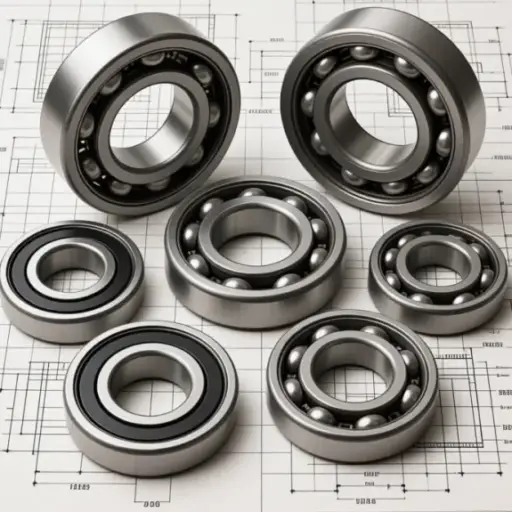
When sourcing or replacing bearings in industrial applications, understanding the 1623 2RS bearing cross reference is essential. Different manufacturers use varying naming conventions, but the core dimensions and performance characteristics remain standardized.
This guide will help you identify equivalent models, avoid costly mistakes, and make confident purchasing decisions.
What Is a 1623 2RS Bearing?
The 1623 2RS is an inch-series deep groove ball bearing designed for moderate loads and high-speed operation. It belongs to the 1600 series and is widely used across mechanical systems.
Key Specifications
- Inner Diameter (d): 15.875 mm (5/8 inch)
- Outer Diameter (D): 34.925 mm (1-3/8 inch)
- Width (B): 11.112 mm (7/16 inch)
- Type: Deep Groove Ball Bearing
- Seal Type: 2RS (double rubber seals)
- Material: Chrome steel (SAE 52100)
The “2RS” designation indicates seals on both sides, providing protection against dust, moisture, and contaminants.
1623 2RS Bearing Cross Reference Chart
Because bearing manufacturers use different suffixes and naming styles, cross-referencing is critical.
1. Common Equivalent Model Variations
These are interchangeable naming formats:
- 1623-2RS
- 1623 RS2
- 1623.2RS
- 1623-2RZ (light-contact seal variant)
These variations refer to the same core bearing dimensions.
2. Cross Reference by Brand
Here are equivalent part numbers across major global brands:
- SKF: 1623-2RS1
- NSK: R1623DDU
- NTN: R1623LLU
- FAG: 1623-2RSR
- Timken: 1623-2RS
Although suffixes differ (DDU, LLU, RSR), they all indicate double-sealed bearings with similar performance.
3. Dimension-Based Substitution (Most Reliable Method)
In real-world applications, the safest way to cross-reference is by matching dimensions:
- 15.875 mm (ID)
- 34.925 mm (OD)
- 11.112 mm (Width)
If these three dimensions match, the bearing is functionally interchangeable in most cases.
Applications of 1623 2RS Bearings
Thanks to its versatile design, the 1623 2RS bearing is used in:
- Electric motors
- Gearboxes
- Pumps and compressors
- Conveyor systems
- Household appliances
Key Advantages
- Low friction and smooth rotation
- Good sealing performance
- Cost-effective and widely available
- Suitable for moderate radial and axial loads
Common Mistakes in Cross Referencing
1. Ignoring Dimensions
Model names vary, but dimensions must match exactly.
2. Confusing Seal Types
- 2RS: Rubber seals (better protection)
- ZZ: Metal shields (lower friction, less sealing)
These are not always interchangeable depending on the environment.
3. Overlooking Precision Grades
Bearings may differ in accuracy:
- ABEC-1 (standard)
- ABEC-3 / ABEC-5 (higher precision)
High-speed or precision equipment requires higher-grade bearings.
How to Choose the Right Cross Reference Bearing
To ensure a correct replacement, follow this step-by-step approach:
Step 1: Confirm Dimensions
Always verify ID, OD, and width first.
Step 2: Select Seal Type
Choose 2RS for better durability in dusty or wet environments.
Step 3: Compare Brands
- Premium: SKF, NSK, FAG
- Cost-effective: OEM or generic manufacturers
Step 4: Evaluate Operating Conditions
Consider:
- Speed
- Load
- Temperature
- Exposure to contaminants
1623 2RS vs Similar Bearing Types
| Bearing Type | Key Difference |
|---|---|
| 1623-2RS | Double sealed, best for protection |
| 1623-ZZ | Metal shielded, lower sealing |
| 1623-Open | No seals, suitable for high-speed clean environments |
In most industrial applications, 1623 2RS is the preferred choice due to its balance of protection and performance.
Final Thoughts
Understanding the 1623 2RS bearing cross reference allows you to:
- Replace bearings accurately across brands
- Reduce downtime and maintenance risks
- Optimize procurement costs
Key Takeaways:
- Dimensions are the ultimate reference standard
- Different brand codes can be directly interchangeable
- 2RS sealing is ideal for most working conditions