Ball bearings 16x42x13 mm are widely used in industrial machinery, electric motors, pumps, conveyor systems, and power transmission equipment. Although this size may appear simple, choosing the correct bearing configuration is critical for equipment reliability, rotational efficiency, and long service life.
Different manufacturers may offer this bearing size in various sealing types, materials, precision grades, and internal clearances. Understanding these differences helps reduce downtime, avoid premature failure, and improve machine performance.
What Does 16x42x13 mm Mean in Ball Bearings?
The dimensions of a bearing describe its physical size and compatibility with shafts and housings.
| Dimension | Description |
|---|---|
| 16 mm | Inner Diameter (ID) |
| 42 mm | Outer Diameter (OD) |
| 13 mm | Bearing Width / Thickness |
These measurements are essential when replacing an existing bearing. Even small dimensional differences can cause vibration, misalignment, or installation failure.
Common Types of 16x42x13 mm Ball Bearings
Deep Groove Ball Bearings
Deep groove ball bearings are the most common type available in this size. They provide:
- Low friction
- High rotational speed capability
- Quiet operation
- Simple maintenance
- Long service life
They are suitable for both radial and light axial loads.
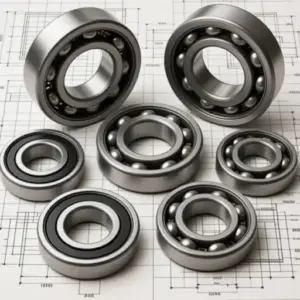
Sealed Bearings (2RS)
2RS bearings use rubber seals on both sides to prevent contamination from dust, moisture, and debris.
Advantages include:
- Excellent sealing performance
- Reduced lubricant leakage
- Longer maintenance intervals
- Better protection in dirty environments
These bearings are commonly used in agricultural equipment, conveyors, and outdoor machinery.
Shielded Bearings (ZZ)
ZZ bearings use metal shields instead of rubber seals.
Main features:
- Lower rotational resistance
- Higher speed capability
- Moderate contamination protection
- Lower operating temperature
They are widely used in electric motors and high-speed applications.
Stainless Steel Bearings
Stainless steel bearings provide corrosion resistance in wet or chemically exposed environments.
Typical applications include:
- Food processing equipment
- Marine systems
- Medical machinery
- Washdown environments
Ceramic Hybrid Bearings
Ceramic hybrid bearings combine steel races with ceramic balls.
Benefits include:
- Higher rotational speed
- Lower friction
- Reduced heat generation
- Improved wear resistance
- Electrical insulation capability
These bearings are often used in precision equipment and high-speed machinery.
Applications of 16x42x13 mm Ball Bearings
Bearings of this size are used across many industries due to their balance between compact dimensions and load-carrying capability.
Electric Motors
Ball bearings help reduce friction and maintain stable shaft rotation in industrial motors and fans.
Agricultural Machinery
Sealed bearings are commonly installed in agricultural equipment exposed to dirt, mud, and moisture.
Conveyor Systems
Conveyor rollers and drive systems rely on smooth, low-friction bearings for continuous operation.
Pumps and Compressors
High-speed rotating equipment requires bearings with stable performance and low vibration.
Power Tools
Compact machinery and handheld tools often use small deep groove bearings for reliable rotation.
Automotive Components
Certain automotive assemblies and auxiliary systems may use bearings in this size range.
16x42x13 mm Bearing Material Options
| Material | Main Advantages |
|---|---|
| Chrome Steel | High strength and cost-effective |
| Stainless Steel | Corrosion resistance |
| Ceramic Hybrid | High-speed performance and low friction |
| Polymer Cage | Reduced weight and quieter operation |
Material selection depends on operating conditions, speed requirements, and environmental exposure.
Sealed vs Shielded Bearings
| Type | Protection Level | Speed Capability | Maintenance |
|---|---|---|---|
| 2RS Sealed | Excellent | Medium | Low maintenance |
| ZZ Shielded | Moderate | High | Periodic inspection recommended |
If contamination is a concern, sealed bearings are generally the better option. For high-speed applications with cleaner operating conditions, shielded bearings are often preferred.
How to Choose the Right 16x42x13 mm Bearing
Load Requirements
Determine whether the application involves radial loads, axial loads, or combined loads.
Rotational Speed
High-speed equipment may require low-friction shielded or ceramic bearings.
Operating Environment
Dusty or wet environments usually require sealed bearings with stronger contamination protection.
Lubrication
Proper lubrication significantly affects bearing lifespan and operating temperature.
Precision Grade
Precision machinery may require tighter tolerances and reduced vibration levels.
Possible Cross Reference and Equivalent Bearings
Equivalent bearing models may vary depending on manufacturer specifications and internal design.
| Brand | Possible Equivalent Type |
|---|---|
| SKF | Depends on series and clearance |
| NSK | May vary by sealing configuration |
| NTN | Equivalent dimensions available |
| KOYO | Custom configurations possible |
Always verify:
- Internal clearance
- Seal type
- Precision grade
- Load rating
- Operating speed
before replacing a bearing.
Common Bearing Problems
Bearing Noise
Noise may indicate contamination, insufficient lubrication, or raceway damage.
Overheating
Excess heat can result from overload, incorrect lubrication, or excessive preload.
Premature Failure
Improper installation and contamination are among the most common causes of early bearing damage.
Lubricant Leakage
Damaged seals or excessive operating temperatures may cause grease leakage.
Maintenance Tips
- Keep bearings clean during installation
- Use the correct lubricant type
- Avoid excessive mounting force
- Inspect seals regularly
- Monitor vibration and temperature
- Replace damaged bearings immediately
Frequently Asked Questions
What is a 16x42x13 mm ball bearing?
It is a ball bearing with a 16 mm inner diameter, 42 mm outer diameter, and 13 mm width.
What industries use this bearing size?
Common industries include industrial automation, agriculture, motors, pumps, conveyors, and power tools.
What is the difference between 2RS and ZZ bearings?
2RS bearings use rubber seals for better contamination protection, while ZZ bearings use metal shields for lower friction and higher speed.
Are stainless steel bearings better?
Stainless steel bearings provide better corrosion resistance but may have different load capacities compared to chrome steel bearings.
Can ceramic bearings run faster?
Yes. Ceramic hybrid bearings generally operate at higher speeds with reduced heat generation.
How do I choose the correct replacement bearing?
Verify dimensions, load requirements, seal type, clearance, and operating conditions before replacement.
Conclusion
Choosing the correct 16x42x13 mm ball bearing is essential for maintaining equipment reliability, reducing downtime, and extending machine service life. Factors such as sealing type, material selection, operating speed, and environmental conditions all influence bearing performance.
For industrial applications, selecting a high-quality bearing from a trusted supplier can significantly improve operational efficiency and long-term maintenance costs.
Bearing maker provides industrial bearing solutions for global customers, including deep groove ball bearings, stainless steel bearings, sealed bearings, and customized bearing products for demanding applications.